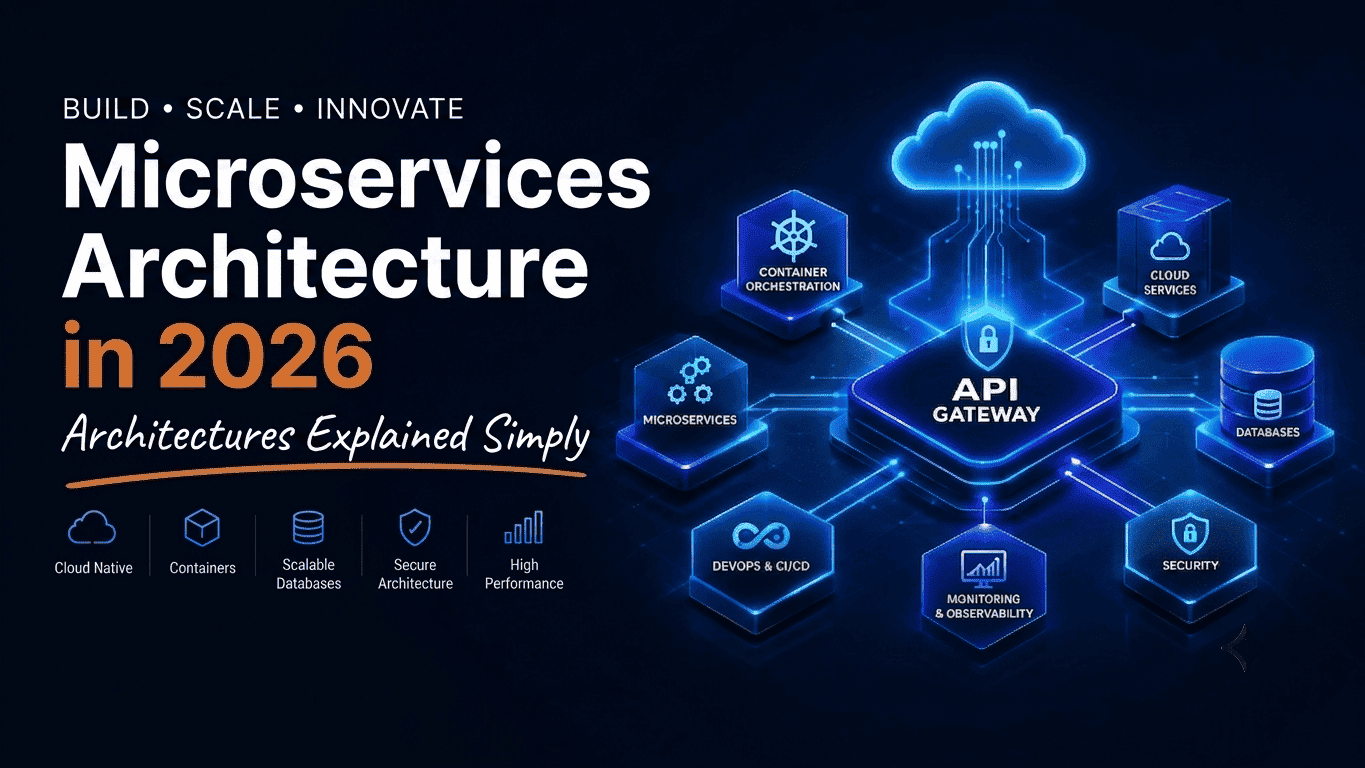
As applications become more complex, businesses need software that can scale, release new features quickly, and remain reliable as traffic grows.
This is one reason microservices architecture continues to be widely used in modern software development.
But microservices in 2026 are about more than simply breaking a large application into smaller services. Modern architectures combine APIs, cloud infrastructure, containers, event-driven systems, observability, automation, and AI-powered services.
In this guide, we'll look at what microservices architecture is, the most important patterns, its benefits and challenges, and how businesses can use it effectively.
What Is Microservices Architecture?
Microservices architecture is a software architecture where an application is divided into multiple small, independent services. Each service focuses on a specific business capability and can be developed, deployed, scaled, and maintained independently.
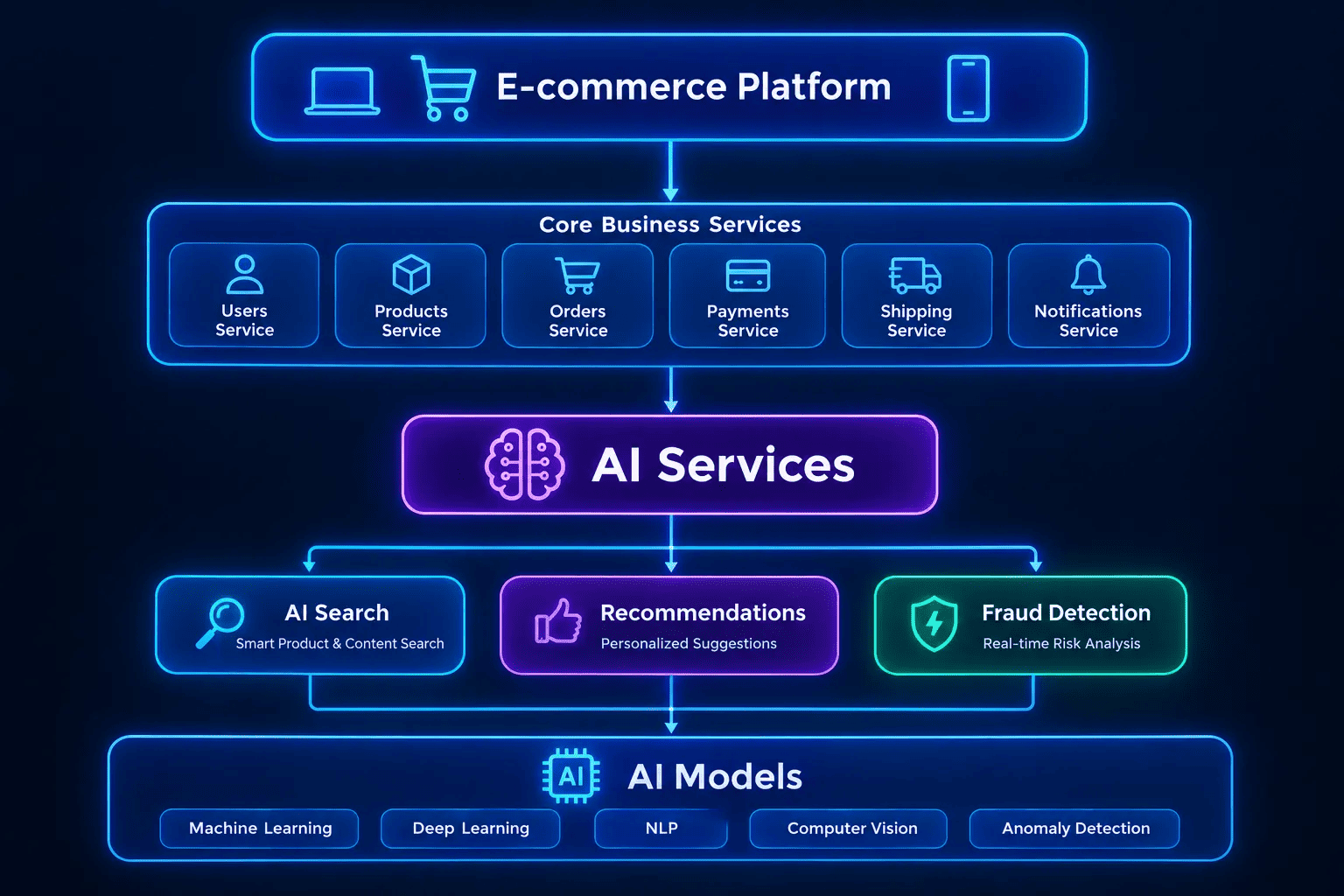
For example, an e-commerce platform might have separate services for:
- User Management
- Products
- Inventory
- Orders
- Payments
- Shipping
- Notifications
Instead of one large application handling everything, each service has a clearly defined responsibility.
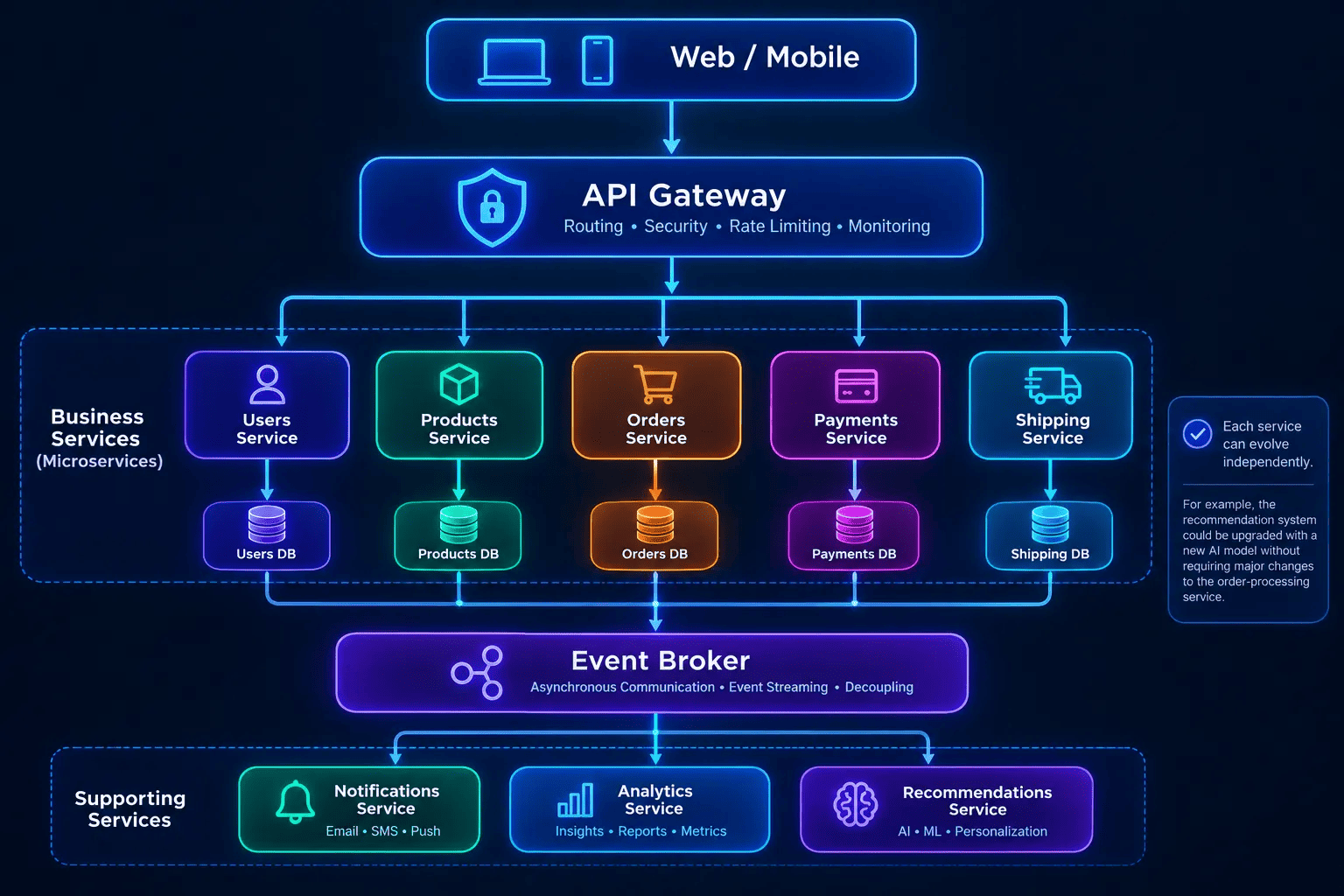
A typical architecture looks like: Web / Mobile App → API Gateway → Microservices → Databases & External Services
This approach makes it easier for development teams to work on different parts of a platform without tightly coupling the entire system.
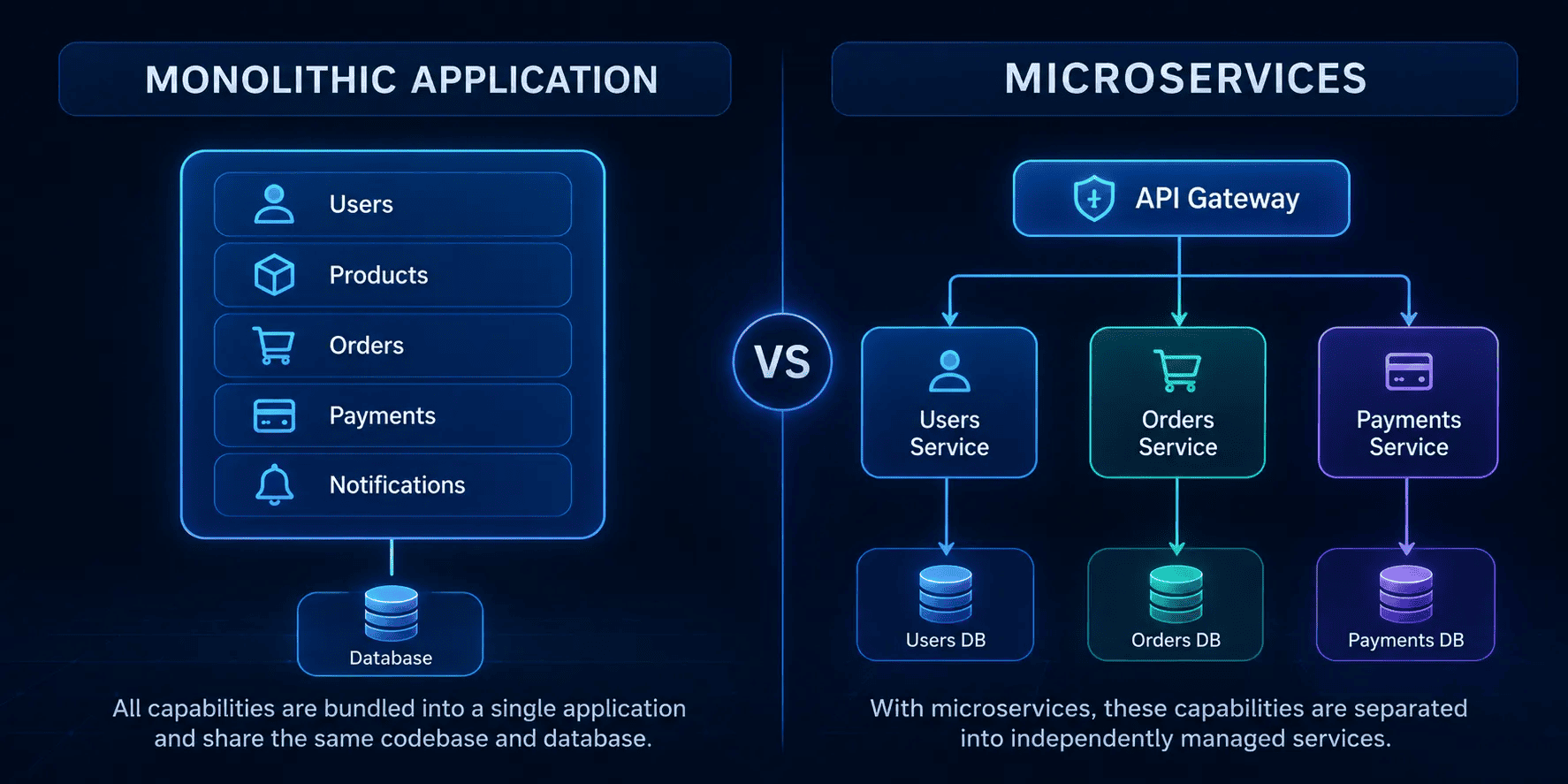
Monolithic vs Microservices Architecture
In a traditional monolithic application, most business functionality exists inside a single application.
Key Microservices Patterns
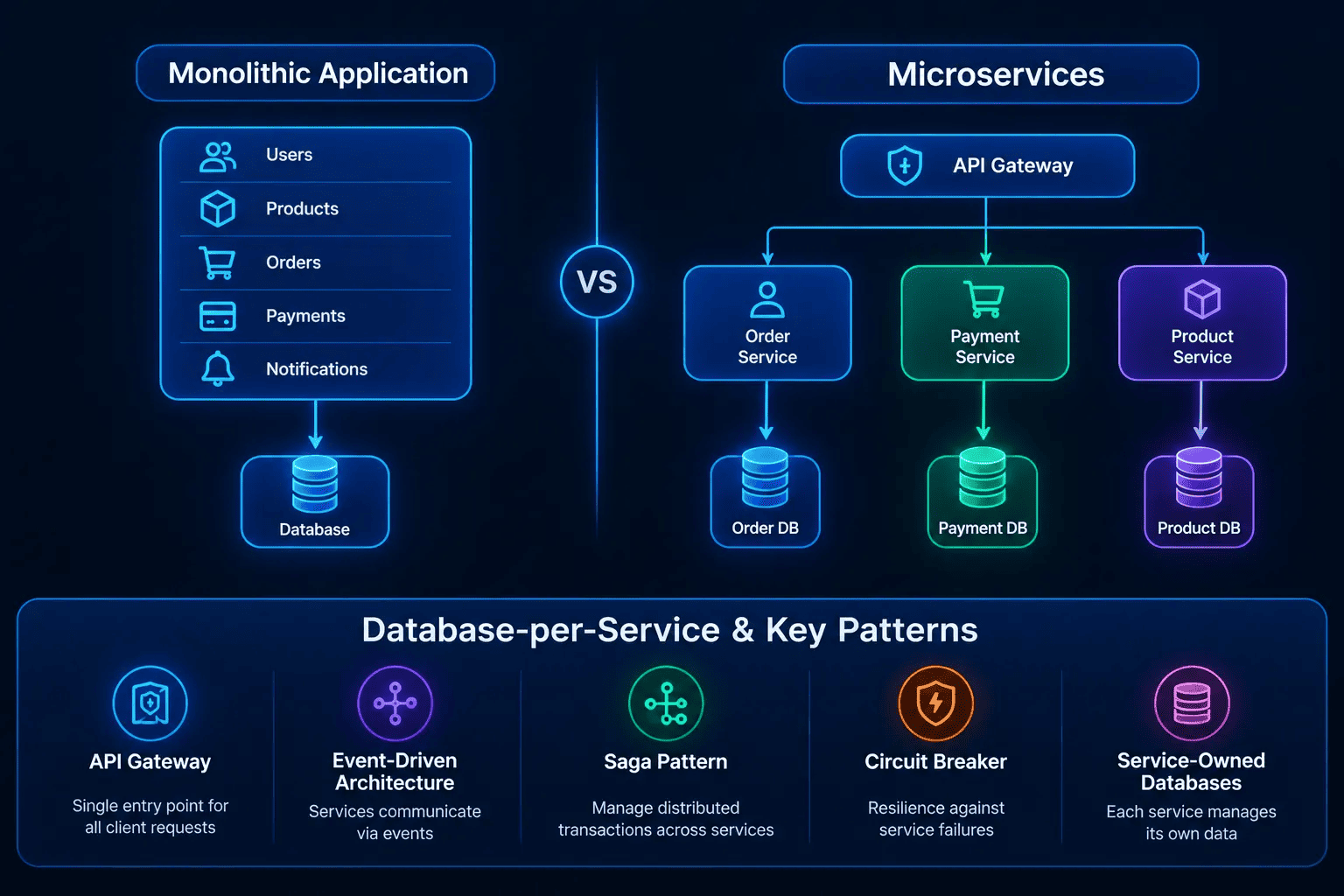
Microservices are not one fixed architecture. Different patterns can be used to solve different technical challenges.
1. API Gateway Pattern
An API Gateway acts as a single entry point between applications and backend services. Instead of a mobile or web application connecting directly to multiple services, requests go through the gateway. It handles:
- Authentication
- Request routing
- Rate limiting
- API versioning
- Request aggregation
2. Event-Driven Architecture
Services can communicate through events instead of relying only on direct API requests. For example, when an order is created, an event is emitted to a message broker, which notifies payment, inventory, and notification services simultaneously. This allows services to remain loosely coupled for asynchronous workflows.
3. Saga Pattern
Microservices often need to perform business operations across multiple services (e.g., Create Order → Reserve Inventory → Process Payment). If payment fails, previous operations must be reversed. The Saga pattern manages these distributed workflows using a sequence of smaller transactions and compensating actions.
4. Circuit Breaker Pattern
If a service becomes temporarily unavailable and other services continue sending requests to it, the failure can spread across the entire application. A circuit breaker temporarily stops requests to an unhealthy service, allowing the system to recover gracefully.
5. Database-per-Service
A core microservices principle is that each service owns its data (e.g., Order Service → Order DB, Payment Service → Payment DB). This reduces tight coupling, though it introduces challenges around distributed data consistency.
Benefits of Microservices Architecture
- Independent Deployment: Teams can update individual services without re-deploying the entire application, enabling continuous delivery.
- Independent Scaling: Scale only the specific components under high traffic (e.g., Product and Order services during a flash sale) rather than the entire infrastructure.
- Better Fault Isolation: A failure in one service doesn't bring down the whole platform when combined with timeouts, retries, and fallback mechanisms.
- Team Independence: Dedicated teams can independently own distinct business capabilities (Payments, Orders, Customer Management) to boost velocity.
- Technology Flexibility: Different services can use the tech stack best suited for their job (Node.js for APIs, Python for AI models, PostgreSQL for transactional data, Redis for caching).
Challenges of Microservices
Microservices are not automatically better than a monolith; they introduce their own trade-offs:
- Distributed System Complexity: Inter-service network communication introduces latency, retries, timeouts, and service discovery management.
- Data Consistency: Synchronizing data across separate databases requires event-driven setups and eventual consistency patterns.
- Monitoring & Observability: Debugging multi-service requests requires centralized logging, distributed tracing, metrics, and automated alerts.
- Infrastructure Cost: Managing containers, networking, and orchestration increases operational overhead and infrastructure expenses.
Real-World Example: E-commerce Platform
In a growing online marketplace, microservices allow each capability to evolve independently. For example, the recommendation engine can be upgraded with a new AI model without touching the core order-processing pipeline.
Microservices and AI in 2026
Instead of embedding resource-heavy AI processing directly into monolithic code bases, modern architectures deploy isolated microservices for AI Search, Product Recommendations, Fraud Detection, and Chatbots. This keeps core business services fast and lightweight while allowing AI models to scale independently on GPU infrastructure.
When Should You Use Microservices?
Microservices are a strong fit if your application has high complexity, multiple engineering teams, rapid scaling demands, or high availability requirements. However, for early-stage products or smaller stores, a well-structured modular monolith is often faster to launch and far cheaper to maintain.
Final Thoughts
The ultimate goal isn't to build as many services as possible—it's to pick the architecture that allows your business to grow without creating unnecessary operational headaches.
Frequently Asked Questions
What is microservices architecture?
It divides an application into small, independently deployable services focused on specific business capabilities.
What are the main benefits?
Independent deployment, isolated scaling, fault tolerance, team autonomy, and technology flexibility.
What are the biggest challenges?
Distributed system complexity, data consistency, multi-service tracing/monitoring, and infrastructure overhead.
Are microservices still relevant in 2026?
Yes, particularly when integrated with event-driven channels, cloud-native tools, and dedicated AI microservices.