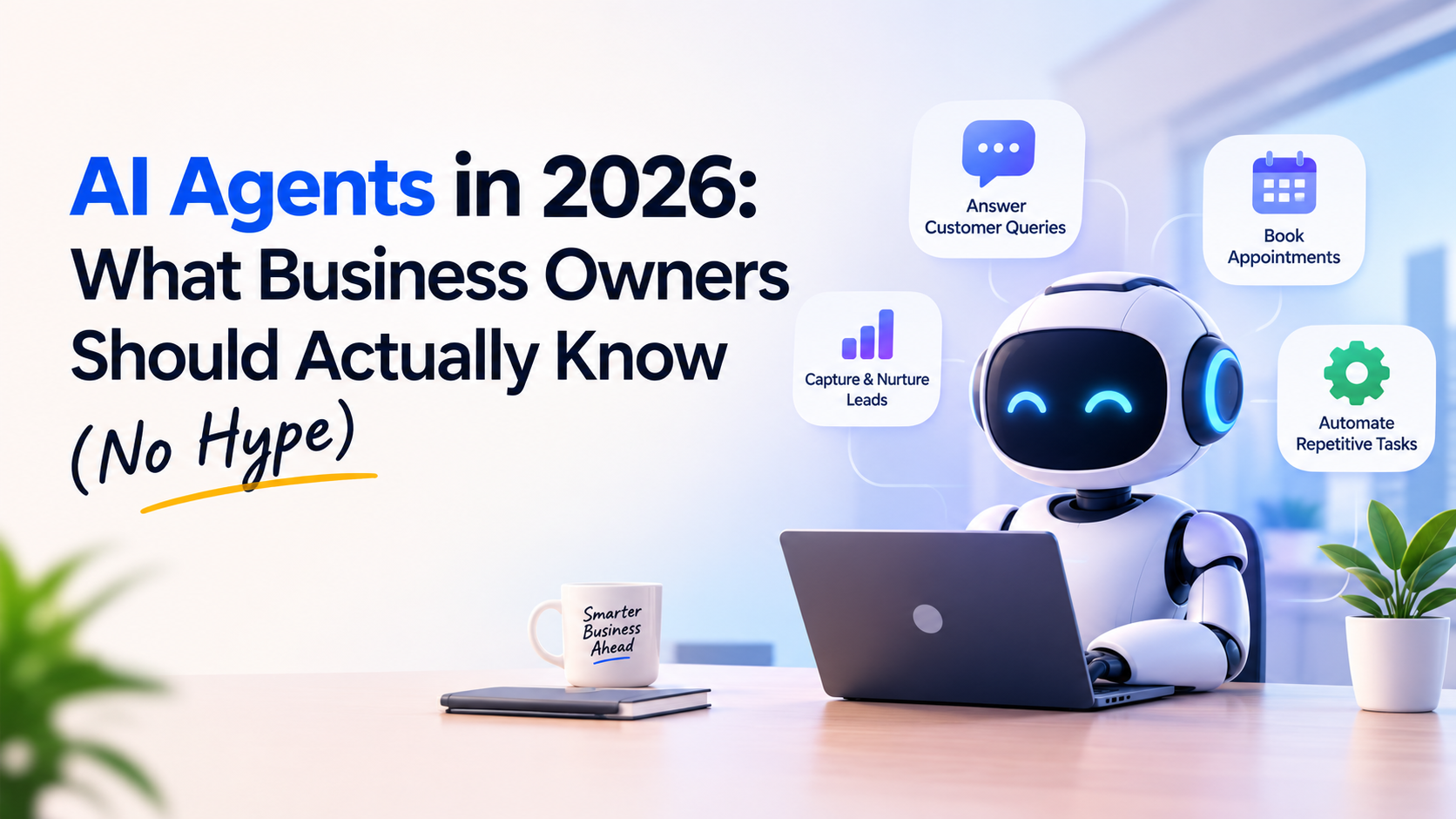
Every second LinkedIn post this year seems to promise that AI agents will run your business while you sleep. Somewhere between the hype and the healthy skepticism, most business owners are left with one honest question:
“what does this actually mean for me, and is it worth doing right now?”
At VolanSoft, we build these systems for a living — not just talk about them. So here's the version without the buzzwords: what AI agents really are, where they genuinely help, where they still fall short, and how to think about adopting them without wasting a budget on a pilot that goes nowhere.
What an AI Agent Actually Is
Forget the sci-fi framing for a second. An AI agent is software that can take a goal, break it into steps, use tools or systems to complete those steps, and adjust when something doesn't go as planned — largely without a human clicking “next” at every stage.
That's the real difference from the chatbots and automation tools most businesses already use. A traditional chatbot answers a question. A traditional automation (like a Zapier workflow) follows a fixed if-this-then-that path. An AI agent does something closer to what a competent junior employee does: it looks at the situation, decides what needs to happen, does it, and checks whether it worked.
It sounds small, but it changes what's automatable. A support ticket that used to need a human to read, verify, and respond to can now be triaged, verified against your order system, and resolved — with a human only stepping in for the edge cases.
Why 2026 Is the Real Turning Point
This isn't just a marketing narrative. Analysts have been watching adoption move from experimentation to actual production use over the past year. Industry estimates suggest a large share of enterprise software will ship with task-specific agents built in by the end of this year, and a majority of companies already running agents report they're now handling real business workflows — not just internal demos.
The more telling number, though, is the failure rate. A significant share of agent projects that started as pilots are being shelved — not because the technology doesn't work, but because the business case wasn't clear, the data wasn't ready, or nobody defined what “success” looked like before starting. That gap between technology readiness and business readiness is exactly where most companies are losing money right now.
Where AI Agents Are Genuinely Useful Today
We're not going to tell you agents can do everything. Here's where we've seen them create real, measurable value:
Customer support and ticket resolution. Agents that can read a query, check order or account status, and either resolve it or escalate it with full context attached — cutting resolution time significantly without frustrating the customer with another bot loop. We saw this firsthand while building our AI-powered interview screening platform, where automating the first-pass evaluation freed up hours of manual review time each week.
Finance and operations workflows. Reconciliation, invoice matching, expense categorization — tasks that are rule-based but tedious, where an agent can work through volume a human team simply can't match. This is the same territory we work in through our business automation services, just with an AI layer added on top.
Lead qualification and follow-up. Agents that read inbound enquiries, check them against your CRM, and prioritize or respond to the right leads faster than a sales team working through a queue manually.
Internal knowledge and reporting. Agents that can pull from your documents, dashboards, and systems to answer “what's our current stock across warehouses” or “summarize this week's support tickets by category” — instantly, instead of someone compiling a report.
Across these use cases, the businesses seeing real ROI have one thing in common: they picked a narrow, well-defined task first, rather than trying to automate an entire department on day one.
Where They Still Fall Short
This is the part most vendors won't tell you.
Agents can still get things wrong — confidently. They can misread ambiguous instructions, act on incomplete data, or take a “reasonable” action that isn't actually what you wanted. They need boundaries: clear rules on what they can do autonomously, what needs human approval, and what they're simply not allowed to touch (customer refunds above a certain amount, for instance, or anything touching sensitive data).
They're also only as good as the systems they're connected to — which is why solid API integration between your agent and your existing tools usually matters more than the agent itself. An agent pulling from messy inventory data will make messy decisions with confidence. Before an agent can help your business, your data and workflows usually need some cleanup — which is often the unglamorous 80% of the work that determines whether the flashy 20% actually works.
And they are not a replacement for a strategy. Bolting an “AI agent” onto a broken process just makes the broken process faster.
A Practical Way to Think About Adoption
If you're a business owner weighing whether to invest in this now, here's the framework we walk clients through:
- Start with a task, not a department. Pick one repetitive, well-defined workflow — ticket triage, invoice processing, lead follow-up — rather than trying to “AI-enable” your whole operation at once.
- Define success before you build. Time saved, cost reduced, response speed improved — pick the number you're trying to move, and measure it from day one.
- Keep a human in the loop where it matters. The best agent deployments we've built aren't fully autonomous — they're agents doing the first 80% of the work, with a human reviewing the last 20% where judgment or trust is involved.
- Get your data house in order first. No agent can compensate for disorganized systems. This is often the real project, disguised as an “AI project.”
- Treat it as infrastructure, not a gadget. The businesses getting lasting value are the ones building agents into how they operate — not running a one-off pilot and moving on.
Where VolanSoft Fits In
We're not chasing AI as a trend — we're building it into the custom software, CRMs, and automation platforms our clients already rely on. Whether that's an AI agent that qualifies leads before they hit your sales team's inbox, or one that keeps your inventory and reporting in sync without manual entry, our approach stays the same as it's always been: understand the operational problem first, then build the system that actually solves it.
If you're trying to figure out where an AI agent could genuinely move the needle in your business — not where it sounds impressive, but where it saves real time and money — that's a conversation worth having before you spend a rupee on development.